
REVIEW · TBILISI OLD TOWN WALKS
Very Friendly Tbilisi Walking Tour (wine tasting & cable car)
Tbilisi feels best on foot. This walking tour stitches together the city’s old lanes, major landmarks, and a few places many first-time visitors miss, so you get the full picture of Georgia’s capital in just about 4 hours. You also get an included cable car ride and time to enjoy the city’s most famous neighborhoods.
I especially like how the route moves smoothly from history to views, and then down into the steam-and-stone world of Abanotubani. I also like the small-group size (up to 15), because your guide can actually answer questions as you walk. One thing to consider: the tour covers a lot of ground in a limited time, so if you want long sit-down breaks, you may find the pace a bit brisk.
In This Review
- Key things I’d prioritize before you go
- Why this Tbilisi walking tour is a smart way to start
- First steps at Pushkin Square, then straight into old Tbilisi energy
- Rezo Gabriadze puppet theater, and that hourly golden angel detail
- Anchiskhati Basilica, where the city’s oldest church sets the tone
- Patriarchate of Georgia area, a royal-to-Russian layers moment
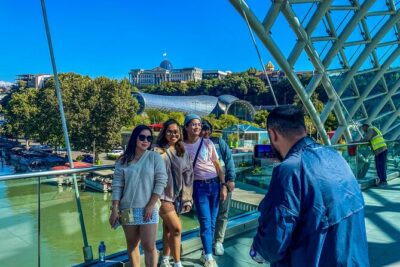
- Bridge of Peace and Rike Park, modern Tbilisi in 15 minutes
- Metekhi Cathedral and the tomb of St. Shushanik
- Vakhtang Gorgasali monument and the view-thinking that follows
- The included cable car ride up to Narikala Fortress
- Kartlis Deda and Narikala, Tbilisi’s defining hill experience
- Juma Mosque below the fortress, a reminder of Tbilisi’s religious mix
- Leghvtakhevi Waterfall and the Abanotubani sulphur bath district
- Meidan Bazaar and Shardeni Street, shopping and street life without stress
- Sioni Cathedral, a fitting final anchor
- Price and value: what you’re really paying for
- Who this tour suits best
- Should you book this Tbilisi walking tour?
- FAQ
- How long is the tour?
- What is the price per person?
- Is the cable car included?
- How big is the group?
- Where does the tour start and end?
- What’s included in the tour?
- Is food or drinks included?
- Are admission tickets required for the main stops?
- Is hotel pickup included?
- Is the tour suitable for children?
- What are the cancellation terms?
Key things I’d prioritize before you go
- Up to 15 people means the guide experience feels personal, not lecture-style
- Rezo Gabriadze puppet theater clock tower includes a golden angel moment once an hour
- Cable car to Narikala is included, saving you time and effort on the hill
- Abanotubani sulphur baths area is built into the route, so you see it up close without planning extra trips
- Bridge of Peace plus Rike Park gives you modern Tbilisi photo stops with a quick payoff
- Friendly guiding style comes through strongly in real feedback, including Anastasia (Fellini Travels)
Other walks through the balconies and backstreets of old Tbilisi
Why this Tbilisi walking tour is a smart way to start

If it’s your first time in Tbilisi, you could wander for days and still not connect the dots. This tour helps you do that, because it links the city’s religious sites, royal-era monuments, and riverfront changes from old to new. It’s also built for practical sightseeing, with short stops that keep things from dragging.
I like that it’s not just landmarks on a map. The guide gives context about what you’re looking at, from why certain churches matter to what makes Narikala’s fortress history so complicated. And because the group is capped at 15, the conversation stays lively.
You’ll spend about 4 hours on foot, with free-entry stops along the way and one paid-included highlight: the aerial tramway. If you’re sensitive to walking time, plan your day so you do not stack another activity immediately after.
First steps at Pushkin Square, then straight into old Tbilisi energy
Your walk starts at Tbilisi Pushkin Square, and from there you move into the older parts of the city where the streets feel narrow, layered, and full of small visual stories. The first goal is to get your bearings fast, because Tbilisi can feel like it has multiple cities stitched together.
Right near the start area, you’ll visit the Tbilisi Wall Ruins tied to the old customs gate. It’s not a huge “wow” site like a palace, but it’s important. You’ll see physical traces of how people once entered and moved through the city, and you’ll understand why Tbilisi’s geography has always mattered.
Rezo Gabriadze puppet theater, and that hourly golden angel detail
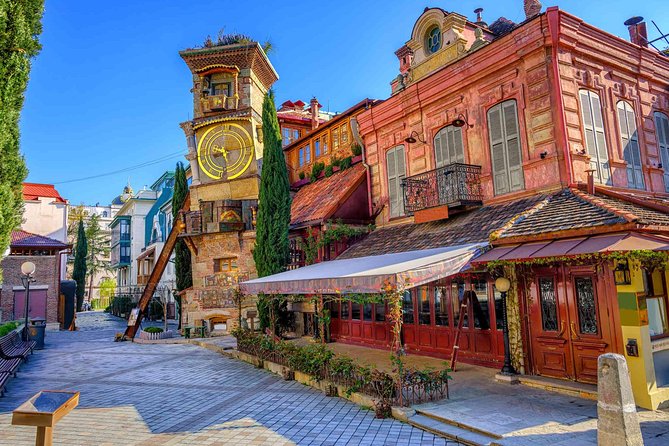
One of the most fun stops is the Rezo Gabriadze Marionette Theater on Shavteli Street. It is one of the first Georgian puppet theaters in Tbilisi, built in 1981, and it has a distinctive architectural look that feels like it belongs to a storybook.
The best part is the clock tower created by Rezo Gabriadze. Once an hour, a golden angel comes out and rings the bell with a small hammer. If your timing lines up, this adds a small burst of theater magic to the walk, and it’s exactly the sort of detail that makes a guided route feel worthwhile.
Even if you catch a moment without the full show, it still works as a “pause” stop. You get a short break, a chance to look up at the tower, and a quick reset before the next church-and-history phase.
Anchiskhati Basilica, where the city’s oldest church sets the tone

Next up is Anchiskhati Basilica, a three-nave church dating back to the 6th century. It’s described as the oldest church building in Tbilisi, which gives you a real anchor point for understanding how far back this city’s religious life stretches.
This stop also connects you to Georgian art history. The church’s name relates to the icon of the Savior that came here from Anchi Monastery in South Georgia in 1664. The guide’s explanation helps you connect names and symbols to the bigger story, instead of treating the church as a photo backdrop.
A practical note: the stop is short, so if you want a longer, quiet church visit, you might want to return later on your own.
More on foot, mostly in Tbilisi and Kutaisi
- Tbilisi Walking Tour Including Cable Car and Traditional Bakery★ 5.0 · 1,310 reviews
- Tbilisi:Evening Walking & Talking Tour with Wine & Boat Ride★ 5.0 · 572 reviews
- Old Tbilisi Highlights walking tour with wine & 10 tastings★ 5.0 · 276 reviews
- Old Tbilisi Tour: Private Walking Tour With Wine Tasting★ 5.0 · 273 reviews
- Private Tbilisi Food Tour: 9 Tastings Walk in Bohemian District★ 5.0 · 227 reviews
Patriarchate of Georgia area, a royal-to-Russian layers moment

From churches to the Patriarchate of Georgia seminary, you pass through another part of the city where power and religion overlap. The site is on the eastern side of Erekle II Square, and construction of the present building began in 1809 on ruins of an older palace used by representatives of Tsarist Russia.
If you like history that explains how borders and empires reshape daily life, this stop helps. It’s not the kind of place you spend a long time inside. It’s more about understanding why the setting looks the way it does.
Bridge of Peace and Rike Park, modern Tbilisi in 15 minutes

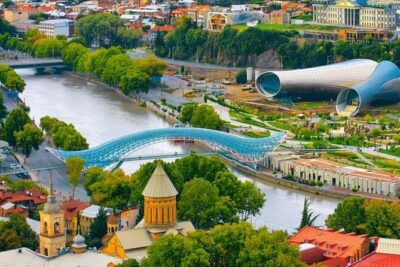
After you’ve had your historical dose, you shift to something lighter: the Bridge of Peace over the Mtkvari River. It was officially opened on May 6, 2010, and it has become one of the city’s symbols of renewal.
The bridge details matter because they show how modern Tbilisi was designed to be seen. The architect is Michele de Luca, and the lighting designer is Philippe Martino, which helps you understand why the bridge feels “intentional” rather than just functional.
Then you walk to Rike Park, a newer park in the city center. From above, the layout creates a large-scale map of Georgia, with pathways that reflect regions of the country. It’s a smart stop for photos and quick orientation, especially if you want to see both river views and a designed sense of national identity.
Metekhi Cathedral and the tomb of St. Shushanik
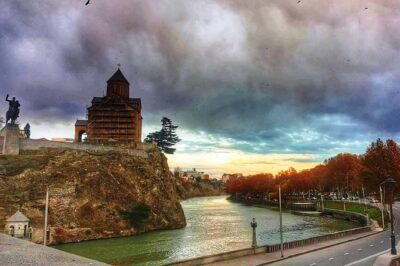
Now the tour leans back into spiritual history with Metekhi Cathedral on the left bank of the Mtkvari River. The main sanctuary centers on the tomb of St. Shushanik. The guide explains the significance of the remains being transferred to the temple after the Armenian-Georgian split in the early 7th century.
Queen Tamar also enters the story here, and it’s one of those details that makes a church stop feel bigger than the building itself. The idea is simple, but powerful: a site isn’t only architecture, it’s where people assigned meaning, protection, and reverence.
Vakhtang Gorgasali monument and the view-thinking that follows
A short stop brings you to the Monument of King Vakhtang Gorgasali. He is identified as Vakhtang I Gorgasali, King of Iberia (Kartli), with his reign placed in the late 5th and early 6th centuries. His story includes alliance with Byzantium and conflict with Sasanian power.
This kind of stop is useful because it helps you “read” the city. Once you know who shaped the early Kingdom of Iberia, the older neighborhoods feel less like random stones and more like a timeline.
The included cable car ride up to Narikala Fortress
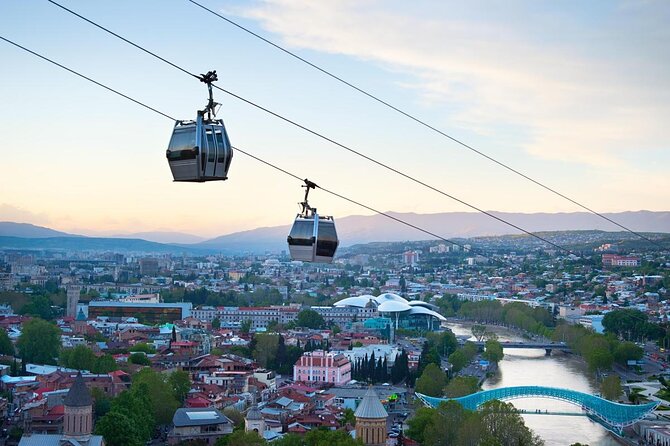
This is one of the biggest value adds: the aerial tramway in Tbilisi is included. The cable car connects the area near Rike Park (Europe Square) to Narikala Fortress, and that alone can save you time and uphill effort.
You’ll benefit from the ride twice. First, it’s quicker than climbing. Second, it gives you a bird’s-eye sense of how the river and old town sit together. Even if you’re not a “view person,” this changes how you perceive Tbilisi, because it shows the city in layers.
Kartlis Deda and Narikala, Tbilisi’s defining hill experience
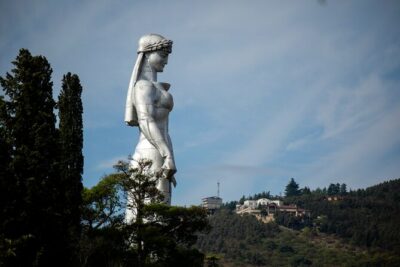
At the Narikala side of the story, you’ll see Kartlis Deda, the Monument Mother of Kartli. It’s one of Tbilisi’s symbols. The statue holds a wine glass in one hand for guests and a sword in the other for enemies.
Then you reach Narikala Fortress, often described as being on the Holy Mountain Mtatsminda. The fortress is said to have fragments dating back to the 4th century AD, with later expansions and work in the 7th-8th centuries. Inside the fortress territory, there’s also St. Nicolas temple dated to the 12th century.
This is the stop where the route pays off hardest if you want big-city atmosphere in a small time window. It’s a hilltop perspective with fortress texture, and the guide’s explanation helps you avoid the common mistake of seeing it as just a viewpoint.
Juma Mosque below the fortress, a reminder of Tbilisi’s religious mix
Not far below Narikala, you’ll see the Tbilisi Mosque (Juma Mosque). It’s described as the only Muslim shrine in the city. The original Sunni mosque was built by the Ottomans between 1723 and 1735, destroyed by Persians in the 1740s, and later rebuilt in stages, including renovations in the late 19th century.
This stop gives you something many city walks skip: the acknowledgement that Tbilisi’s identity is not single-note. It helps you understand the city as a long crossroads, shaped by many groups over time.
Leghvtakhevi Waterfall and the Abanotubani sulphur bath district
From the fortress viewpoint, the tour drops into the steam-and-stone zone around Leghvtakhevi Waterfall. The waterfall is noted as being 22 meters tall, and the name comes from Georgian, linked to fig trees in the area.
Then you reach Abanotubani, known for its sulphur baths. This is where the tour becomes truly Tbilisi, because you’re not just looking at monuments. You’re standing in a historic district where hot springs shaped daily life. The baths are described as being built at different times, roughly in the 17th-19th centuries, with the oldest being Irakli bath.
If you want the city’s sensory side, this is where you’ll get it. Even if you only look around, the area has that instantly recognizable “spa street” mood, with old stone and bath entrances.
A short add-on point includes Chreli Abano, described as a popular sulfur bath spot for tourists and Georgians. It’s also described as looking like a mosque from a distance, which is a fun visual clue when you’re trying to orient yourself.
Practical reality check: the tour segment here is time-limited, so you might not get a full bath experience. But you’ll learn what the baths are, how they developed, and why this district has its reputation.
Meidan Bazaar and Shardeni Street, shopping and street life without stress
After the baths area, you’ll move toward Meidan Bazaar, a traditional commercial square known historically with different names. It’s positioned as a center where you can browse for traditional Georgian wine, handmade accessories, souvenirs, and local delicacies.
This is one of those stops that helps you avoid shopping regrets later. You can look, compare prices in your own head, and decide if something fits your trip. The guide can also help you navigate what feels touristy versus what feels truly local, but you still control the pace.
Then you walk to Jan Shardeni Street, a pedestrian street tied to cultural and social life. After reconstruction in the 19th century, it was named Shardeni after Jean Chardin. The street and its nearby pedestrian parallels are lined with galleries and cafes.
Even if you do not buy anything, this stretch helps you end the day with an easy stroll. It’s a good place for a quick drink or snack on your own, since the tour information specifically says food and drinks are not included.
Sioni Cathedral, a fitting final anchor
The last big cultural anchor on the walk is Sioni Cathedral (the Assumption of the Blessed Virgin Mary). It’s described as a cross-domed temple, with origins in the 5th century and connected to Georgian architecture traditions. Since 1920, it has been described as a Patriarchal Cathedral.
This stop works well at the end of the route because you’ve already absorbed a lot of religious context. Now you can look at the building with better understanding of why it matters and what kind of spiritual role it plays in modern Tbilisi.
Price and value: what you’re really paying for
At $27.24 per person, this tour is priced as a mid-range walking experience, and the value comes from a few specific things you actually get, not just “a guide.” You’re paying for a local guide, bottled water, and a route that includes the cable car segment.
Most stops are described as free admission, which keeps your personal costs under control once you’re on the street. The included cable car is the big practical win, because it’s both transport and a viewpoint upgrade.
One note for expectation setting: the tour title mentions wine tasting, but the included items listed here do not specify food or drinks as included, only bottled water. If wine tasting is a main reason you booked, I strongly recommend you confirm what is included in your departure, and whether any tastings happen during the walk.
Who this tour suits best
This is a great match if you want:
- A guided first-day route through Old Tbilisi plus major riverfront landmarks
- A walk that mixes history, churches, fortress views, and sulphur bath culture
- A small-group feel, up to 15 people
- The convenience of an included cable car ride
It may be less ideal if you prefer slow travel with long rests, or if you want a deeper dive into any one place. This is about breadth with helpful context, not about standing inside one site for hours.
Should you book this Tbilisi walking tour?
I’d book it if you want to see a lot that makes sense together and you enjoy learning while you walk. The combination of fortress viewpoints, Abanotubani bath culture, and the Bridge of Peace and Rike Park modern contrast is a smart mix for a half-day.
I’d pause and confirm details if wine tasting is a must-do for you, since the provided “included” list only clearly calls out bottled water. Also, if you have limited mobility or dislike uphill areas, plan your energy, because even with the cable car, it’s still a full walking circuit.
If you go in with that mindset, you’ll leave with a strong mental map of Tbilisi, and you’ll understand why the city’s identity is both old and continuously rebuilding.
FAQ
How long is the tour?
The tour lasts about 4 hours.
What is the price per person?
The price is listed as $27.24 per person.
Is the cable car included?
Yes, the aerial tramway in Tbilisi (cable car) is listed as included.
How big is the group?
The tour is described as a small-group experience with a maximum of 15 people.
Where does the tour start and end?
It starts at Tbilisi Pushkin Square and ends near Orbeliani Bazaar, at Площадь Орбелиани.
What’s included in the tour?
Included items listed are bottled water and a local guide.
Is food or drinks included?
Food and drinks are listed as not included.
Are admission tickets required for the main stops?
Most stops are listed with free admission tickets, while the cable car is included.
Is hotel pickup included?
Hotel pickup and drop-off is listed as not included, though the highlights mention that hotel pickup may be available. You should confirm what applies to your booking.
Is the tour suitable for children?
Children must be accompanied by an adult.
What are the cancellation terms?
You can cancel up to 24 hours in advance for a full refund.
More Georgian Tours We Have Read Closely



Everything Else Across the Caucasus

Old Tbilisi, Three More Ways
Other Georgian tours we have been through, from the Black Sea to the Kakheti vineyards
- Private Adorable City Tour of Tbilisi
★ 5.0 · 3 reviews - Tbilisi Airport to Gudauri, Bakuriani, Batumi, Tbilisi
★ 5.0 · 3 reviews - Private Wine Tour In Kakheti Region with 7 Wines and Lunch
★ 5.0 · 3 reviews - Two Capitals in One Day: Tbilisi and Mtskheta Combo Tour
★ 5.0 · 3 reviews - Private Effortless transfer from Tbilisi to Gudauri ski resort
★ 5.0 · 3 reviews - Tbilisi to Gudauri Stepantsminda Private Transfer
★ 5.0 · 3 reviews
Tbilisi Old Town Walks, compared.
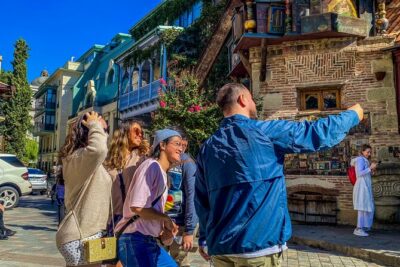 ★ 5.0Tbilisi Walking Tour Including Cable Car and Traditional BakeryFrom $191,310 reviews
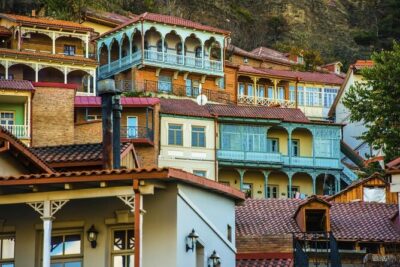 ★ 5.0Old Tbilisi Highlights walking tour with wine & 10 tastingsFrom $15276 reviews
 ★ 5.0Old Tbilisi Tour: Private Walking Tour With Wine TastingFrom $39273 reviews
 ★ 5.0Tbilisi Old Town Walking Tour with a Local GuideFrom $38168 reviews
 ★ 5.0Tbilisi old town & soviet heritage – Private driver-guided TourFrom $7783 reviews
 ★ 5.0Private Walking Tbilisi City Tour (Day Trip)From $5969 reviews
 ★ 5.0Old Town and Beyond: A Tbilisi Silk Road Feast with Culinary BackstreetsFrom $12562 reviews
 ★ 5.0Private Walking Tbilisi City TourFrom $4536 reviews
Browse the lists this tour appears in