
REVIEW · MTSKHETA & JVARI MONASTERY
Uplistsikhe-Borjomi-Gori-Mtskheta
That first viewpoint hits fast. In this private Uplistsikhe-Borjomi-Gori-Mtskheta day trip, you get sweeping Georgian scenery, then religion and archaeology, then a side of Soviet history in Gori, and you finish in the old capital around Svetitskhoveli Cathedral.
Two things I really like: the friendly, accommodating driver-guide approach, with people like Mamuka and Ani/Anna showing up in recent reviews, and the way the route mixes nature stops with major cultural sights without feeling like you are rushing blind. One thing to consider: several attractions charge separately (especially around Borjomi, plus the Stalin museum and Uplistsikhe), and most stops are timed tightly, so you will want to move efficiently.
This tour works best when you like variety. You start early at 9:00 am in Tbilisi, you use a mobile ticket, and your group stays small with a private format (up to 3 per group). If you want one exact match of what you will do for 7 to 9 hours, you will appreciate this structure, but keep in mind the road time between each stop is part of the deal.
Key highlights at a glance
- Jvari Church views above Mtskheta, including the dramatic confluence of Aragvi and Kura/Mtkvari
- Borjomi Central Park with time for natural mineral water, plus a cable car option for top views
- Gori’s Stalin house-museum visit to contrast with the deeper pre-modern layers elsewhere on the route
- Uplistsikhe rock-hewn cave town and its long timeline, from around 1000 BC through the medieval period
- Svetitskhoveli Cathedral in Mtskheta, including access to several major Orthodox sanctities
- Driver-guides in a private group format, with recent feedback calling out Mamuka and Ani/Anna for helpful pacing and warmth
In This Review
- Entering The Jvari Church Overlook Above Mtskheta
- Borjomi-Kharagauli National Park Drive-By Then Borjomi Central Park
- Gori’s Stalin House-Museum, A Different Kind of Georgia
- Uplistsikhe Cave Town, Rock-Hewn and Surprisingly Big
- Svetitskhoveli Cathedral in Mtskheta, When Faith Meets National Identity
- Why The Route Feels Balanced, Even With Tight Time Windows
- Value For Money: What $179 Per Group Buys You
- Who This Tour Suits Best
- Should You Book This Uplistsikhe-Borjomi-Gori-Mtskheta Day Trip?
- FAQ
- What is the duration of the tour?
- Where does the tour start and end?
- What time does the tour begin?
- Is pickup offered?
- Is this a private tour?
- How many people are in a group?
- Is the tour ticket mobile?
- Which stops have free admission?
- What is included and not included regarding admission tickets?
- What is the cancellation policy?
Entering The Jvari Church Overlook Above Mtskheta
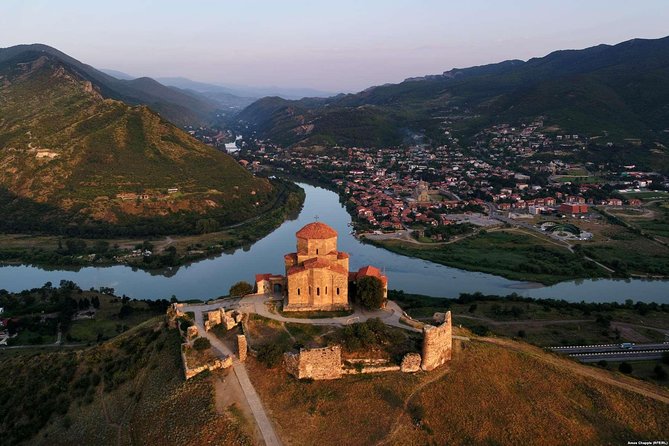
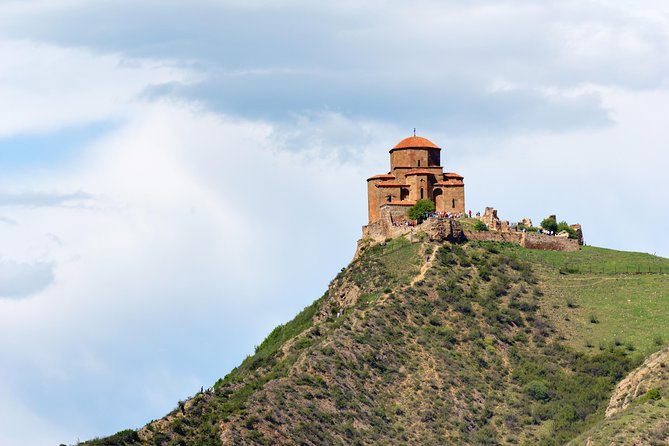
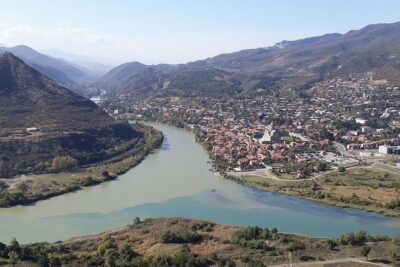
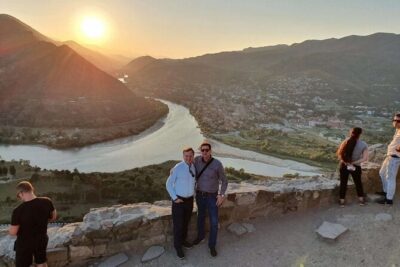
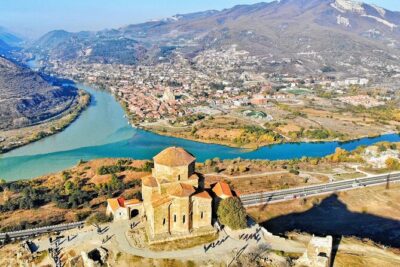
Jvari is the kind of stop that sets the tone for the whole day. You leave Tbilisi and head to the monastery site where the big draw is the panorama: wave-like mountains, the city of Mtskheta below, and the junction where the Aragvi and Kura, also called Mtkvari, meet.
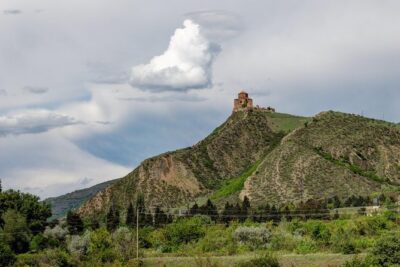
This is also where the spiritual timeline gets interesting fast. The monastery started in the 4th century, soon after Christianity took hold in Georgia, and the main large church was built later, in the 11th century. That long arc is part of the charm, because you are standing in a place that has kept its importance across centuries, not just decades.
You only get about 30 minutes here, and that is exactly why it is a good first stop. Arrive, take in the views, and get your bearings quickly, before you move on. The admission ticket for this stop is listed as free, so you can spend your energy on the viewpoint instead of budgeting last-minute.
Practical note: this early in the day is when the light often feels best for photos. If you care about pictures, you will probably want to do the “look first, linger second” routine. Grab the wide views, then use the remaining minutes for details.
More of Mtskheta and the Jvari hill above the confluence
Borjomi-Kharagauli National Park Drive-By Then Borjomi Central Park
After Jvari, the route starts shifting from churches to countryside. On the way toward Borjomi, you pass through the Borjomi-Kharagauli National Park area. Even if you do not stop inside the park, the drive is part of the experience, because the region is framed as one of Europe’s largest protected areas.
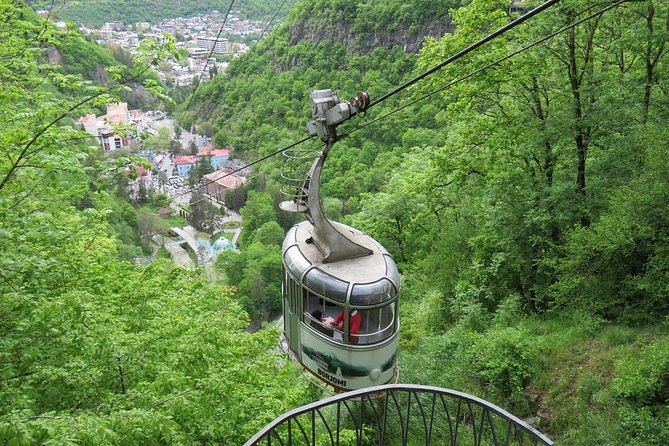
Then you reach Borjomi itself and get the classic park-and-water moment. In Borjomi Central Park, you can drink natural mineral water and take a stroll in the green spaces around the center. If you like viewpoints, the cable car adds another layer, letting you ascend to the plateau area above the city for a wider look over Borjomi.
This stop is about 45 minutes, and admission is listed as not included. The details given point to cable car use, so plan on paying separately if you want that ride. The good tradeoff is that the time window is long enough to do two things well: a quick water break and a short walk, then decide whether the cable car is worth your energy that day.
Why Borjomi matters on this particular tour: it is a pressure release after temples and museum-heavy stops. You get a sensory break. Mineral water plus fresh air works. Even if you skip the cable car, the central park walk can be enough to reset your brain.
Gori’s Stalin House-Museum, A Different Kind of Georgia
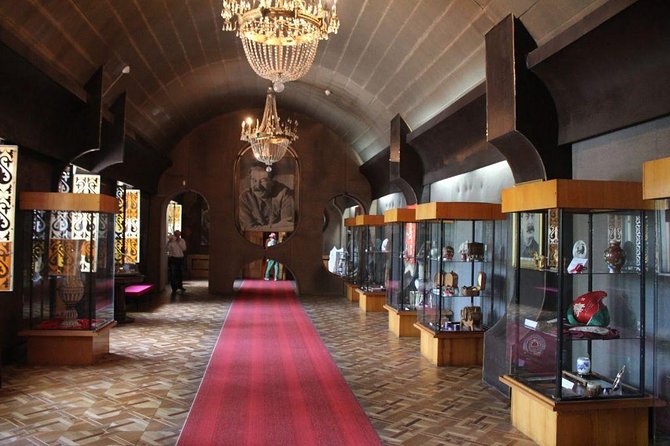
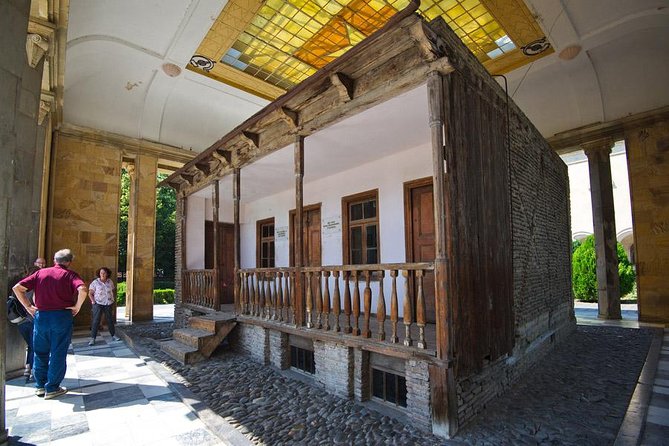
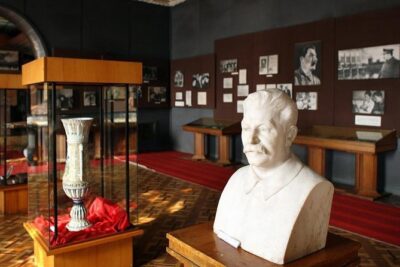
Next comes Gori, known as the birthplace of Joseph Stalin. If you are looking at this itinerary like a story, this is the “20th century chapter.” Everything else on the route leans toward ancient spirituality or pre-Christian archaeology. Gori pulls in the Soviet era.
The stop is around 40 minutes at the Stalin house-museum, and the admission is not included. That makes timing important. You do not want to show up late here, because the museum visit is your dedicated window for this theme.
Gori is also described as sitting in the Kartlia valley at the confluence of the Kura and the Liakhi. Even if you are mostly inside a museum for a portion of the visit, the setting explains why the place has long mattered strategically. Mountains surround it, and valleys at junctions tend to collect people, power, and history.
A balanced way to handle this stop: go in with curiosity, not judgement. You are not being asked to agree with a political figure. You are seeing how a nation’s story can shift, how regimes rewrite everyday life, and how a birthplace becomes a museum stop for visitors.
If you want to keep the day cohesive, think of this as one perspective among many, not the final answer to Georgia’s past.
Uplistsikhe Cave Town, Rock-Hewn and Surprisingly Big
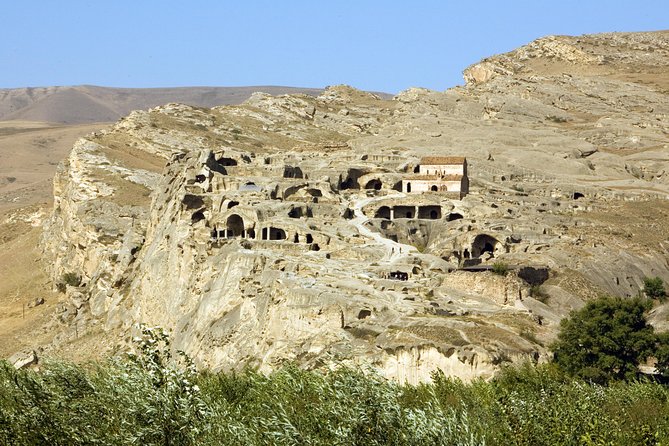
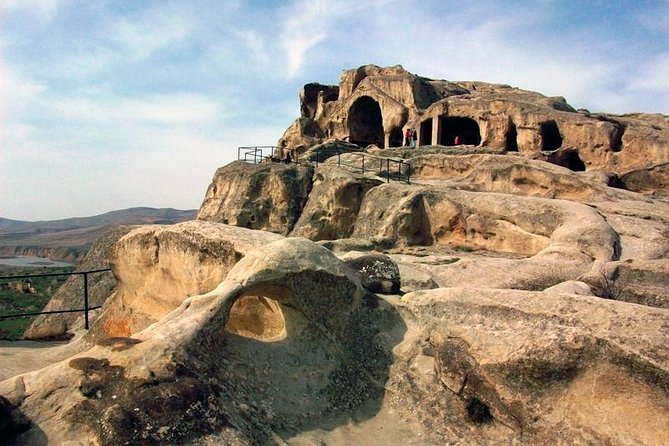
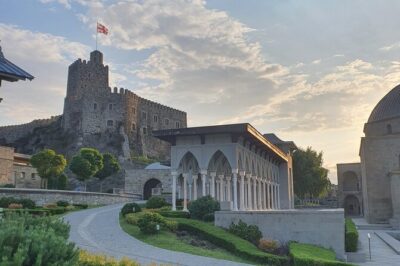
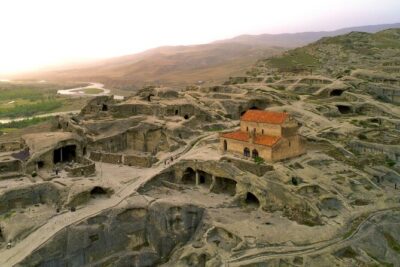
Then you swing into Eastern Georgia’s ancient core with Uplistsikhe, often translated as Lord’s Fortress. This is where the day becomes physical. You are walking through a rock-hewn town that has long ago been abandoned.
Uplistsikhe’s timeline is part of what makes it stand out. It is described as being founded in the late Bronze Age, around 1000 BC, and it continued to be inhabited until the 13th century AD. At its peak, the place is said to have housed around 20,000 people. That number helps you imagine scale, especially because what you see today is only what remains.
It also had major pre-Christian importance. Between the 6th century BC and the 11th century AD, it was one of the most important political and religious centers of pre-Christian Kartli, a predecessor of the Georgian state. The tour info points out what you visit today, the Shida Qalaq area, covering about 40,000 square meters.
Your visit time is about 40 minutes, and admission is listed as not included. With this kind of site, shorter is better if you approach it with the right questions. Look for how the architecture uses the rock. Notice how religious spaces and everyday spaces likely relate. Ask your guide to connect what you see with the long timeline, from ancient settlement through medieval use.
A practical consideration: cave towns are uneven by nature. You will want comfortable shoes and a pace that lets you take in details without slipping into a fast shuffle. If you hate walking, this may feel like the hardest stop of the day.
Svetitskhoveli Cathedral in Mtskheta, When Faith Meets National Identity
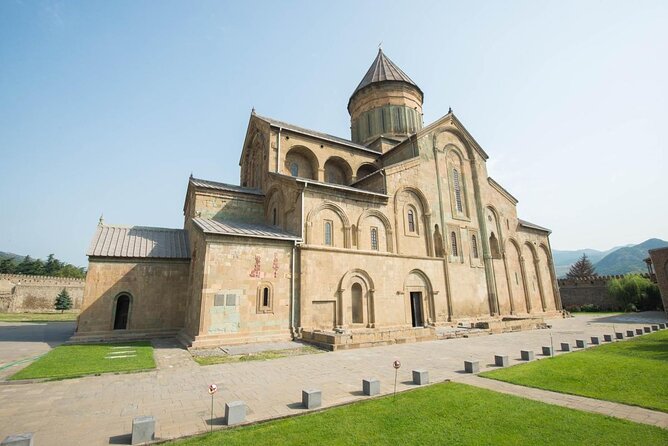
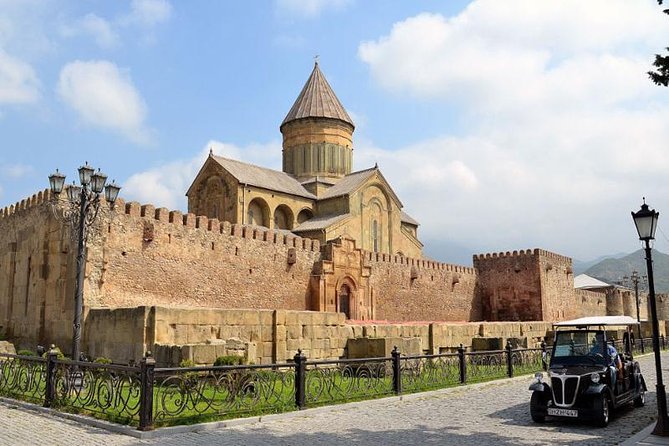
After Uplistsikhe, the tour returns you to Mtskheta, Georgia’s old capital, for one of the key religious sites on the route: Svetitskhoveli Cathedral. This is the most clearly “free admission” stop listed, with a ticket listed as free and about 30 minutes allotted.
Construction started in 1010 and finished in 1029. That quick window does not make it feel modern, though. The cathedral is described as holding four great sanctities of the Orthodox world. The list provided is specific: the Mantle of Isaiah the prophet, the robe of Jesus Christ, a particle of Andrew the Apostle, and the wood cross where small particles of the cross are kept.
Even if you are not deeply religious, this stop hits because it shows how tangible objects can shape identity. In places like this, faith is not an abstract concept. It is something tied to artifacts, tradition, and long-held reverence.
The time is short, but that is okay. You can still do the essentials: notice the setting, take in the cathedral space, and let the sanctities list give you something concrete to listen for from your guide. If you are into architecture, use these 30 minutes to focus on the feeling of the interior, not just the outside photos.
Other runs west to Gori and the Uplistsikhe rock town
- Mtskheta-Jvari-Uplistsike-Chronicle of Georgia, PRIVATE Trip★ 5.0 · 105 reviews
- Day tour to Chronicles of Georgia, Gori city, Uplistsikhe cave★ 5.0 · 86 reviews
- Ancient Georgia Group Tour: Mtskheta,Jvari, Gori, Uplistsikhe★ 4.5 · 73 reviews
- Mtskheta – Jvari + Gori – Uplistsikhe Tour★ 5.0 · 49 reviews
- Mtskheta – Gori – Uplistsikhe caves • Private tour★ 5.0 · 24 reviews
Why The Route Feels Balanced, Even With Tight Time Windows
A day trip like this lives or dies by pacing. Here, the stop durations are fairly consistent: 30 minutes at Jvari, 45 minutes in Borjomi Central Park, 40 minutes for the Stalin house-museum, 40 minutes for Uplistsikhe, and 30 minutes at Svetitskhoveli Cathedral.
That creates a rhythm. You alternate big-view moments, museum-style learning, and walking time in rock-hewn spaces. The result is a day that covers different kinds of interest: religion, nature, archaeology, and political history.
You also get built-in variety because the route connects major Georgian regions. You start in Tbilisi, then reach Mtskheta, travel to Borjomi, head to Gori, and then loop back to Mtskheta again. This is not just sightseeing in a straight line. It is a practical way to see several “Georgias” on one schedule.
If you get motion sick, think about the drive time as part of planning. The itinerary is road-heavy, and while the tour promises pickup and private format, it still means you will spend hours in the car. Bring water and plan to use the stops to reset.
Value For Money: What $179 Per Group Buys You
The price is $179 per group, up to 3 people. For a private tour format with pickup from Tbilisi, that can be good value, especially if you are traveling with friends or family and you want a guided day that does not require you to coordinate multiple tickets and transport plans.
What helps your wallet here is the mix of included versus extra costs. Jvari Church and Svetitskhoveli Cathedral list free admission tickets. Then the other main activities, like Borjomi cable car time, the Stalin museum, and Uplistsikhe, are listed as not included. So the cost is not totally all-inclusive, but you can predict where extra fees will likely land.
I also think the value is in the human factor. Recent feedback highlights friendly, accommodating guides, and specific names like Mamuka and Ani or Anna come up. One review notes that the guide helped with good restaurant and shopping places. Even if meals and shopping are not listed as part of the official itinerary, that kind of local guidance can save time and help you avoid tourist traps.
In plain terms, if you like structure and you want someone to handle the route and context, this price can make sense. If you are the type who hates guided stops and wants long free time in each place, you might feel boxed in.
Who This Tour Suits Best
This is a strong fit for you if you want a single day that checks multiple boxes. You should enjoy it if you care about Orthodox sites, pre-Christian archaeology, and nature breaks, and you also do not mind a museum stop connected to Soviet history.
It also works well for small groups who want flexibility but still want expert context. The private format means the guide can keep things moving at your pace, within the stop-time structure.
Based on how the guides are described in feedback, you will likely appreciate a warm, friendly atmosphere, with clear communication in English and support from the driver-guide.
Should You Book This Uplistsikhe-Borjomi-Gori-Mtskheta Day Trip?
Book it if you want a guided, compact way to see the main anchors of this part of Georgia, without turning your day into spreadsheet math. The itinerary flows across viewpoints, spiritual landmarks, and rock-hewn history, and the guide team, including Mamuka and Ani/Anna in recent accounts, seems to land well with visitors looking for friendliness and clarity.
Skip or reconsider if you know you dislike short visits. Many stops here are 30 to 45 minutes, so you will not get long, slow wandering in each place. Also budget for extra admissions around Borjomi, the Stalin museum, and Uplistsikhe since those are listed as not included.
If you like structure, you will have a satisfying day. If you prefer total freedom, you might want a slower multi-day plan instead.
FAQ
What is the duration of the tour?
The tour lasts about 7 to 9 hours.
Where does the tour start and end?
It starts in Tbilisi, Georgia and ends back at the meeting point.
What time does the tour begin?
The start time is 9:00 am.
Is pickup offered?
Yes, pickup is offered.
Is this a private tour?
Yes, it is private, and only your group will participate.
How many people are in a group?
The price is per group, up to 3.
Is the tour ticket mobile?
Yes, it includes a mobile ticket.
Which stops have free admission?
Jvari Church and Svetitskhoveli Cathedral have free admission tickets.
What is included and not included regarding admission tickets?
Admission tickets are listed as not included for Borjomi Central Park, the Stalin Museum, and Uplistsikhe Cave Town.
What is the cancellation policy?
You can cancel for a full refund up to 24 hours in advance of the experience start time. If you cancel less than 24 hours before, the amount paid is not refunded.
The Cave City and the Borjomi Valley


West to Gori and the Rock Town
Mtskheta and the Hill Above It
Other Georgian tours we have been through, from the Black Sea to the Kakheti vineyards
- Private Adorable City Tour of Tbilisi
★ 5.0 · 3 reviews - Tbilisi Airport to Gudauri, Bakuriani, Batumi, Tbilisi
★ 5.0 · 3 reviews - Private Wine Tour In Kakheti Region with 7 Wines and Lunch
★ 5.0 · 3 reviews - Two Capitals in One Day: Tbilisi and Mtskheta Combo Tour
★ 5.0 · 3 reviews - Private Effortless transfer from Tbilisi to Gudauri ski resort
★ 5.0 · 3 reviews - Tbilisi to Gudauri Stepantsminda Private Transfer
★ 5.0 · 3 reviews
Mtskheta & Jvari Monastery, compared.
 ★ 5.0Day Trip to Mtskheta Gori and UplistsikheFrom $291,801 reviews
 ★ 5.0Mtskheta,Jvari,Bazaar,wine tasting,Chronicles of GeorgiaFrom $20730 reviews
 ★ 5.0Mtskheta-Gori-UplistsikheFrom $90112 reviews
 ★ 4.5Mtskheta, Jvari, gori, uflistsikhe, history and panorama (group tours)From $19107 reviews
 ★ 5.0Mtskheta-Jvari-Uplistsike-Chronicle of Georgia, PRIVATE TripFrom $68105 reviews
 ★ 4.5Tbilisi – Mtskheta – Jvari. Full City Tour on Hop On Hop Off BusFrom $4091 reviews
 ★ 4.5Ancient Georgia Group Tour: Mtskheta,Jvari, Gori, UplistsikheFrom $2473 reviews
 ★ 5.0Ancient Mtskheta and Chronicle of Georgia half day tourFrom $6566 reviews
Browse the lists this tour appears in